Does your bus assembly line really “know” the model of each car?
Bus Assembly Production Line
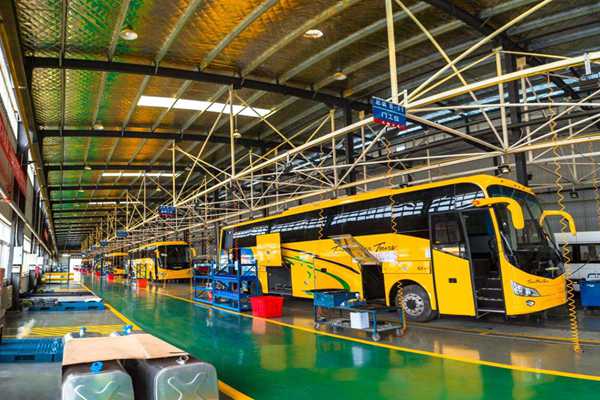
We have deep expertise in bus assembly processes. To meet the unique needs of bus manufacturing, we developed a full-process automated production line. It covers chassis assembly, powertrain assembly, interior assembly, and vehicle inspection. We provide customers with complete solutions from process planning to implementation.
Line Structure and Conveying Technology
This production line uses a composite conveying structure: “ground drag chain + double plate chain”. It scientifically matches the process characteristics of each bus manufacturing stage.
Chassis Assembly Line
The chassis assembly line uses a ground drag chain conveying system. It has a chain pitch of 250mm, a carrying capacity of 3.5 tons, and infinitely adjustable speed (2.0–8.0 meters/minute). The effective length is 66 meters, with 22 standard stations for on-line chassis assembly.
Key chassis processes flow continuously, including rear and rear axle sub-packaging and suspension system assembly. The line body uses an upper and lower vertical return layout. Empty pallets are automatically returned to the starting point via an underground passage, saving factory space and ensuring a closed logistics loop.
Whole Vehicle Assembly Line
The entire vehicle assembly line is equipped with a double plate chain structure. The plate chain width is adapted to the passenger car’s wheel track range. Frequency conversion enables accurate speed control (0.5–3 meters/minute), and PLC programming realizes intermittent beat transportation.
Given the long body and high center of gravity of passenger cars, we installed liftable support tooling on the plate chain (lifting stroke: 500–1000mm). Workers can adjust the vehicle body height according to assembly content. This turns high-altitude work (like interior assembly and wiring harness laying) into comfortable ground operations, greatly reducing labor intensity.
Integrated Bus Core Technology
Chassis Assembly Process
A 2° climbing section at the end of the ground drag chain raises the chassis by 200–400mm. This forms a dedicated tire assembly station equipped with an intelligent tightening system.
Each gun collects torque curves, speed, and tightening angles in real time. It ensures nuts are tightened step-by-step as required, and data is automatically uploaded to the MES system for full traceability.
Front and rear axle assembly uses a KBK flexible spreader and guide positioning device. The leaf spring support aligns automatically during bridge body falling, keeping assembly accuracy within ±2 mm.
Powertrain Assembly
For new energy buses, the line uses an EMS electric monorail transportation system. It carries 2–5 ton battery packs and motor assemblies with millimeter-level positioning via laser ranging. AGV cars complete automatic docking of battery packs and chassis.
For traditional fuel buses, the engine gearbox sub-assembly line uses tray-type transportation. After sub-assembly, the powertrain and body are accurately joined via a lifting mechanism.
Interior Decoration and Final Assembly
The interior decoration line uses accumulating and releasing conveying. A foot valve-controlled stop is set between workstations to support synchronous operation and online caching.
When the body enters the interior station, a lifting skateboard lowers the roof to 1.6 meters. Workers can assemble top components (air conditioners, ducts, luggage racks) while standing. Modular components (instrument consoles, seats) are delivered via independent sub-assembly lines for JIT on-time supply.
Vehicle Inspection and Debugging
Four-wheel positioning stations, rotary drum test benches, and rain inspection lines are installed at the end of the production line. Vehicles are transported to the inspection area via plate chains, where dynamic testing (braking, steering, lighting) is completed online. Unqualified vehicles can quickly switch to the repair branch line to maintain smooth main line flow.
Intelligent Control System
The production line is controlled by a Siemens S7-1500 PLC. Each station connects to distributed IO modules via a Profinet bus, enabling real-time monitoring of the entire line’s operating status.
The system supports vehicle type identification and automatic switching of process parameters. When buses of different lengths and wheelbases enter the line, conveying speed, station stop position, and lifting height are matched automatically, realizing multi-variety mixed-line production.
Key workstations are equipped with a visual inspection system. It automatically identifies and alarms defects like missing key bolts and inadequate wiring harnesses.
Full-Process Technical Services
We provide end-to-end technical services: from process simulation and mechanical design to installation and debugging. We customize the line layout according to customer factory conditions to ensure deep compatibility between the production line and bus manufacturing processes. This helps customers build an efficient, stable, and sustainable modern assembly base.