Cost Down 30% Directly! Secret to Optimization and Upgrade of the RMU Assembly Line
1. System Overview
This production line is designed for automated assembly of medium-voltage ring main units (RMUs). It uses a modular loop layout with a flexible roller conveyor system. This setup creates a closed-loop manufacturing environment covering component loading, module pre-assembly, final integration, and finished-product dispatch.
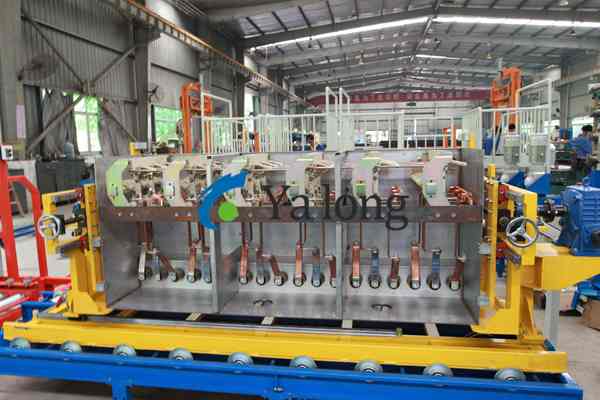
The centerpiece is a multi-station tilting fixture mounted on a heavy-duty roller conveyor. The fixture is finished in industrial yellow for high visibility. It has dual-side pneumatic/manual tilting with handwheel fine-adjustment. It can rotate and lock at any angle between 0° and 90°. This eliminates ergonomic and spatial constraints for bottom cabling and top-mounted component installation.
The conveyor uses zinc-plated or polyurethane-coated steel rollers. Each roller segment handles over 500 kg. Variable-frequency motors provide precise indexing between stations.
2. Core Assembly Processes
2.1 Enclosure Frame Pre-Assembly
This station establishes the structural foundation. Pneumatic clamps position cold-rolled steel side panels, cross-beams, and columns. Servo-controlled spindles tighten bolts with ±5% torque accuracy. This ensures geometric tolerances meet IEC 62271-200 mechanical strength requirements.
2.2 Three-Station Parallel Assembly
The core area has a three-station parallel assembly cell. Each station operates independently. They have insulation-mounting fixtures, copper-busbar alignment templates, and electronic work instructions.
Key operations include:
- Vacuum breaker/load-switch installation – A fixture inserts the spring mechanism into the cabinet. It keeps coaxial alignment within 0.1 mm.
- Busbar system assembly – Tin-plated copper busbars are pre-formed on CNC machines. They are positioned and torqued. Contact resistance is kept ≤50 µΩ.
- Cable and earthing-switch assembly – The three-position switch is tested through ≥2,000 operation cycles.
2.3 Gas-Tank Sealing and Leak Detection
For gas-insulated RMUs, a dedicated station handles tank assembly. Stainless steel tanks are joined by laser or TIG welding. Welds are checked by X-ray or helium leak testing. Leakage must be ≤0.1% per year.
The station then dries and fills tanks with SF₆ or dry air/N₂ mix. It also installs density monitors and rupture disks.
2.4 Secondary Wiring
The tilting fixture locks at 90° for upright wiring. Technicians install terminal blocks, transformers, relays, and monitoring units.
A pre-cut wire harness system is used. Power cables and control wiring are routed separately to prevent interference.
3. Conveyor and Takt Control
The line uses accumulating roller conveyors. Pneumatic stoppers and pop-up transfers are between stations. This allows:
- Flexible timing – Cycle times adjust from 8 to 15 minutes per product.
- In-line buffering – 1–2 units can wait between stations. This balances workflow.
- Smooth heavy transfers – Gears or friction wheels move loaded cabinets smoothly. Cabinets weigh up to 800 kg.
4. Quality Control and Safety
The line has full traceability. RFID or barcode readers capture data at each station. Data includes torque, pressure, and test results. Each product gets an electronic record.
Critical stations have Andon lights. Any assembly issue triggers a line stop and alert. Quality engineers respond quickly.
The tilting mechanism has dual safety locks. The conveyor is guarded with fencing and light curtains. This meets ISO 13849-1 safety standards.
5. Technical Advantages
The “rigid + flexible + collaborative” design boosts efficiency by over 30%. It reduces operator strain and quality variation.
Modular design allows quick changeover. Switching from 12 kV to 24 kV models takes under two hours. This meets market needs for customized equipment and faster delivery.
If you have any questions or needs about the automated assembly line, please contact us via email: yu.yalong@outlook.com