Awesome! The automobile assembly line goes from chassis to complete vehicle in one go!
Automobile Assembly Line: Process Logic & Manufacturing Rhythm
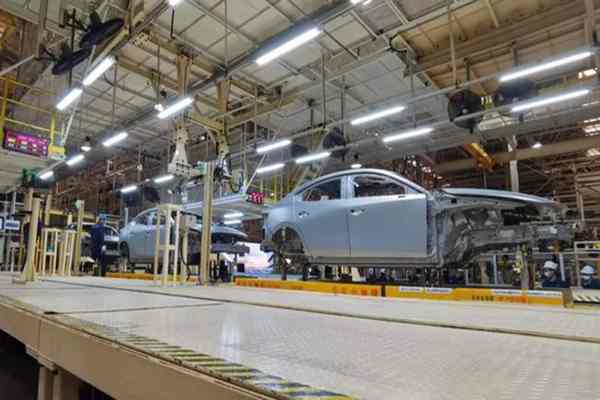
The image captures an assembly workshop, the most process-intensive and complex of the four major manufacturing stages. The silver-gray body is suspended on a yellow pallet, moving at a constant speed along the ground conveying track. The steel roof above is densely fitted with linear lighting and power rails. This three-dimensional space utilization is a defining feature of the automobile assembly line.
Composite Delivery System Architecture
The automobile assembly line uses a coordinated ground chain and overhead transportation system, rather than a single mode.
The skid conveyor visible in the image supports the car body. The yellow tray connects precisely with process holes at the body’s bottom, ensuring positioning accuracy during transfer. RFID tags embedded in the pallet interact with readers at each station to transmit vehicle configuration data in real time. This enables the line to automatically call the correct tightening procedures and BOMs during mixed-model production.
Robotic arms and power-assist devices slide along overhead aluminum alloy tracks, forming an “accompanying supply” network. When the body reaches a workstation, spreaders lower heavy parts like instrument panels, seat modules, or tires to the installation position. This layout maximizes ground space for operations and material caching, while eliminating manual heavy lifting risks.
Core Assembly Stages & Process Timing
Final automobile assembly is divided into three main sections: interior line, chassis line, and final line. The image shows an area near the chassis or final line. At this stage, the body has completed coating and entered intensive mechanical and electronic system integration.
Interior Assembly
This stage includes wiring harness laying, instrument panel docking, and air conditioning piping connection. As the vehicle’s “nervous system,” wiring harnesses use strict error-proof designs. Differentiated keyway structures on interfaces prevent short circuits from misinsertion.
The instrument panel uses an overall modular pre-assembly strategy. It is pre-integrated with airbags, the central control screen, and air ducts on a sub-assembly line. The complete module is then installed into the body, consolidating dozens of processes into one precise alignment.
Chassis Assembly
This stage focuses on power system and walking mechanism integration. The engine and gearbox assembly is transferred to the vehicle’s underside via an automatic lifting platform. Multi-shaft synchronous lifting controls powertrain installation angle errors to within millimeters.
Connections for suspension swing arms, steering gears, and brake pipelines involve critical torque points. Electric tightening tools replace traditional pneumatic tools. Each bolt’s tightening curve is uploaded to a quality database in real time, enabling full lifecycle traceability.
The car body in the image has no doors, indicating it is in the “doorless assembly” phase. Some factories pre-assemble doors with glass risers, speakers, and wiring harnesses on separate lines. The doors are then integrated at the end of the final line, compressing main line cycle times through parallel operations.
Human-Machine Collaborative Work Interface
Automobile assembly lines remain labor-intensive, but the human-machine relationship has evolved fundamentally.
Electronic signage above workstations displays status information in red and green. Green indicates work is completed within cycle time. Red triggers the Andon system, summoning team leaders and material personnel for immediate response. This shifts quality control from “post-event inspection” to “process intervention,” catching issues before they flow downstream.
Worker tools feature intelligent sensing capabilities. Electric screwdrivers include built-in angle encoders and torque sensors. They automatically lock and alarm if slippage or under-tightening is detected. Material picking systems use light guidance or electronic labels to reduce loading errors. These tools do not replace workers, but free their attention for fine adjustments requiring experience and flexibility.
Production Line Flexibility & Manufacturing Philosophy
A core capability of the automobile assembly line is “multi-variety, small-batch” flexible response. The same line can switch between fuel and new energy vehicles in hours, even supporting mixed-flow production of left- and right-hand drive models. This flexibility comes from modular conveying system design, parametric workstation control, and synchronized, rhythmic supply chain operations.
The linear lighting and metal structure in the image convey a sense of industrial order. The assembly line’s ultimate goal is to transform the complex assembly of tens of thousands of parts into a predictable, controllable, and continuously optimized sequence. Every bolt’s torque, every connector’s insertion feel, and every vehicle’s flow rhythm are precisely controlled in this system.
If you have any questions or needs about the automated assembly line, please contact us via email: yu.yalong@outlook.com