Small batches, multiple models? The bicycle assembly line said: Leave it to me
1. Overview of Production Line Technology
Core Technical Characteristics
Flexible Conveying System
The production line uses a standard station spacing design (usually 1.2–1.5 meters per station). It is equipped with pneumatic lifting and rotating fixtures. The conveyor belt supports forward/reverse rotation and segmented control, simplifying process adjustment and exception handling.
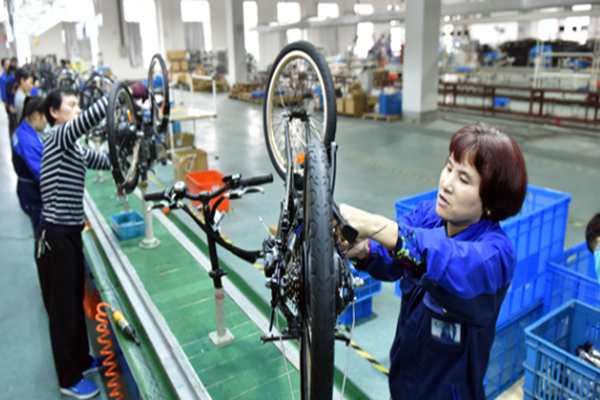
The vertical assembly mode (visible in the picture) lets workers complete key processes at an optimal ergonomic height. This greatly reduces labor intensity for tasks like wheel installation and brake debugging.
Intelligent Workstation Configuration
Each workstation integrates an independent air source interface (orange spiral air pipe), tool rack, and material box. This enables “hands-on” material retrieval. Buffer areas are set between workstations to balance production beats.
The blue turnover box in the picture enables lean distribution of parts. It works with the Kanban management system to achieve JIT production.
Quality Traceability System
Key workstations are equipped with torque wrench data interfaces and scanning equipment. These tools record each vehicle’s assembly parameters in real time.
From frame number entry to finished product warehousing, the entire data process can be traced back. This ensures product quality is fully controllable.
2. Bicycle Production Process
Front Assembly (Frame Pretreatment)
Frame on-line and five-way components pre-installation. Installation of front fork, bowl set, and handle.
Transmission System Preparation
Press fit the center shaft and crank set using hydraulic press-in equipment. This ensures interference fit accuracy.
Pre-assemble the teeth plate and chain. Install and debug rear, forward, and shift handles.
Lock the flywheel with constant torque control to prevent wire slipping.
Wheel & Brake System Assembly
Assemble wheel sets and braking systems. Test wheel hub and spoke tension with a special tensiometer.
Complete automatic or semi-automatic inner/outer tire assembly.
Install and run-in test rim brakes or disc brake systems.
Final Assembly & Commissioning
Position and install the rear wheel using special fixtures. This ensures rear fork gear size accuracy, with a deviation ≤1mm from the frame center line.
Integrate front wheels and front brakes. Adjust brake pad parallelism and grip to meet GB3565 braking performance standards.
Fine-tune the transmission system. Observe guide wheel and flywheel tooth alignment through the window to ensure smooth shifting without tooth skipping.
Terminal Testing & Packaging
Conduct vehicle road feeling simulation tests. Perform 100% dry/wet braking performance tests.
Run airtightness tests for hydraulic brake systems. Complete appearance quality inspection and protective packaging.
3. Summary of Technical Advantages
The vertical assembly process (shown in the picture) is ideal for mountain bikes and road bikes. It solves the space occupation problem of large vehicle horizontal assembly.
The open line layout supports rapid model changes. It is compatible with multiple categories of 16–29-inch wheel diameter models, meeting flexible manufacturing needs for small batches and multiple varieties.